Showing posts with label values. Show all posts

Wednesday, July 14, 2021

Spirit of the game

Though I was not a natural sportsman, forces associated with school and family pushed me into various sporting activities which (as I see even more clearly in retrospect than I did at the time) I endured rather than enjoyed.

Back then I pooh-poohed the idea that sports, especially team sports, were character-building. Quite the opposite, I thought. Observing the behavior of teammates and opponents alike, I came to believe that playing sports only serves to bring out our worst qualities. I have come to modify this point of view however.


One positive thing which can be said for traditional games and sports is that, because they reflect (at least to some extent) the harsh and intractable realities of a wider world, they serve to counter Walter Mitty-like tendencies. And this could be seen to be ever more important as gaming and virtual reality technologies extend the possibilities of personalized escapist fantasies in ways that Thurber could never have imagined.


Sporting contests can also teach you to lose – and to win – with grace and equanimity. This may be more about manners than morals but it is no less important for that.


As I see it, the only strictly moral benefit of an initiation into traditional sporting culture relates to the idea of fair play: of playing by the rules – and the spirit of the rules. I don’t want to go on about this. I could elaborate and give examples etc., but I am wary of moralizing. Besides, I am inclined to think that if these concepts are not real to you already, nothing I say will make them so.


I don’t want to claim that there is this special way of looking at human interactions – i.e. in terms of fair play and abiding by the spirit of agreed-upon rules or laws – which is accessible only to those who have had the benefit of certain experiences in childhood or adolescence, though it's possible that this is the case.


Some experience with sports or games may (conceivably at least) represent a necessary condition for seeing things in the way I describe, but it is certainly not a sufficient condition. For there are and always will be those natural thugs who bring their thuggishness to everything they do, including sport. In the realm of sports and games these people are often feared, but they are (or at least were in my experience) generally despised by players and sophisticated spectators alike.


The failing or failed sportsman is often a devoted sports fan, and (from about the age of ten) I was definitely that. I have autographs of many of the cricketing greats to prove it. But as I grew older I gradually lost interest. Moreover, changes in the general culture of the game were making it progressively less attractive. Now sports exist for me only to the extent that my exposure to them helped to form me and to the extent that they feature in my personal memories (two quite different things).


Technical and aesthetic factors are important but it is ultimately the human side of things which give sports an abiding interest to players and spectators alike. It helps that the conflicts and dramas usually stop short of anything too distressing. In wars, you have death in battle; in politics moral dilemmas, all sorts of unpleasantness and very little in the way of style or grace or beauty.


Sports and games occupy a protected space. In this and in other ways adult sports – at their best, at any rate – can be seen to represent, like the arts, a kind of benign hangover, an extension of certain aspects of childhood.


What prompted these reflections was coming across, by chance, an old cricketing story from the early 20th century. The story is quite moving, actually, and worth retelling. But, though it probably has some emblematic significance, my original idea – to see it as underscoring "the massive gulf which lies between the sporting culture which characterized the British Empire and the professional sporting culture which dominates today's world" – was clearly overblown. So scratch that. I’ll just tell the story. Make of it what you will.


First a bit of background to set the scene. Victor Trumper was born in 1877 in the British colony of New South Wales. A natural sportsman and brilliant cricketer, he was much loved and revered, both for his playing and for his natural humility. He is probably best remembered today as the subject of a photograph by George Beldam, taken when the batsman was in full flight at The Oval in London. This image is probably the most famous in the game's history. Dancing down the pitch, with a huge backswing, Trumper is poised – perfectly balanced – to execute a straight drive.


Trumper was one of the most gifted strokeplayers of all time. The writer A.A. Thomson recorded recollections of one of his great innings: "It was glory, it was wonder. Old men who saw it recall it with tears…" Trumper died of Bright's disease in 1915, at the age of 37.


As a very young man, leg-spin bowler Arthur Mailey encountered Trumper – his idol – in a club game in Sydney.


"This meeting had been nervously anticipated by Mailey," writes Chris Waters in an historical piece for the Yorkshire Post. "[M]ight something happen to prevent his hero from playing in the match (“a war, an earthquake, Trumper might fall sick”), or might Mailey’s captain not bring him on to bowl against the maestro, fearing that the youngster might take a terrible pounding?"


But Trumper played and Mailey was indeed brought on to bowl to him. And Mailey achieved something beyond his wildest dreams – he had Trumper stumped off a perfect googly.


As Trumper walked past Mailey on his way back to the pavilion, he smiled, patted the back of his bat and said, "It was too good for me."


Mailey recalls in his autobiography that he felt no sense of triumph as he watched the receding figure.


"I felt like a boy who had killed a dove," he wrote.


[This piece was published earlier in the year at The Electric Agora.]

Saturday, October 24, 2020

Cinema: a personal perspective

[This is the first part of a piece I wrote recently for The Electric Agora. The final section of that piece – focussed on Ingrid Bergman – I will post separately at a later date. The EA article elicited some interesting comments, by the way.]

It is impossible to put an exact date on it, but around 1990 I changed my mind about movies – or at least new movies. I was increasingly indifferent to them. Even many films of a type I would normally have appreciated had become positively painful to watch.

An appreciation of the arts is a very personal and tenuous thing. It can be seen almost as faith-based. A character in one of Iris Murdoch’s novels used to visit the National Gallery in London and these visits were for him uplifting, like a religious experience. But for some reason he lost the faith, as it were, and the magic no longer worked. In this case, it was not the Gallery which had changed, but the man.

In the case of my about-face on cinema, however, the man stayed pretty much the same, I think. It was the films which had changed – and the world which they represented. I am not talking about the external world here so much as the ideas behind the films. The ideas and stories being offered were simply no longer interesting to me.

During my childhood years, we lived near one of those grand old Art Deco cinemas. It was family owned and its best days (the 1940s?) were long gone. It struggled to survive. Cutting costs to the bone, the management would show one classic mainstream movie (Lawrence of Arabia, say, or Born Free) for many months on end, sometimes for more than a year.

In terms of genre and content, as a child I favored science fiction in the tradition of Jules Verne and H.G. Wells; as an adult, I gravitated to character-based narratives centered around families, friendships and ordinary life. In some ways my cinematic preferences were affected by my parent's views.

My father had grown up in the early days of film. Apart from Chaplin, whom he admired, he showed little interest in the cinema. He was a voracious reader, however, and a big fan of George Bernard Shaw. He approved of the 1938 film Pygmalion (for which Shaw himself wrote the screenplay). He enjoyed the musical My Fair Lady which was also based on Shaw’s play. But a combination of social conservatism and a predilection for solitary reading predisposed him to see the cinema as something of a passing fad for which he had little use.

My mother was much younger than my father and had more modern and progressive views. As a teenager she was influenced by Bertrand Russell’s popular essays. From her early years she had been an avid movie-goer and she talked to me about the actors and movies she had loved. Many of these movies were shown on television when I was a child.

Lately I have been watching or rewatching old English, European, American and some Japanese films. One of the things which I find interesting is trying to see patterns in my preferences. There are various personal factors at play, of course. One gravitates towards writers and directors (as one does towards personal acquaintances) with whom one shares temperamental or cultural affinities. There is also an ideological dimension. But I shy away from films which attempt to be in any way manipulative in this regard.

Any kind of “ism” or ideology is suspect as far as I am concerned. If ideology is taken to refer to a personal framework of values and moral priorities, however, the concept is unexceptionable and applies to us all.

Though each of these individual value frameworks is unique, it is the fact that they overlap with the value frameworks of others which makes them relevant and viable, which gives them traction in the social world.

Cinema, in its own small way, demonstrated the importance of a shared vision. The classic cinema experience – the crowd of silent strangers nestled together in the warmth and the darkness – works best when values are shared at a deep level.

That’s all over now, for me at any rate. But at least these old films still exist and are readily accessible to individuals interested to know how it was back then so that they might have a better sense of our cultural trajectory and – looking to the future – a clearer view of cultural and moral possibilities.


Saturday, August 10, 2019

Sex, schisms and pseudo-scholarship

I have been following – via The Electric Agora and via Twitter (where I maintain a fitful and tenuous personal presence*) – certain recent sex/gender identity debates and, more generally, the internecine conflict between various feminist and other progressive factions. I have not been participating in these clashes and skirmishes. They are not my battles.

I will say here, however, that I support the view (which Daniel Kaufman has articulated through EA articles and through the EA Twitter account) that much psychological and physical harm is being done to children and others, especially in relation to sex/gender “transitioning”. There is no doubt that young children need to be protected from the actions of a group of people who are at once the victims and promoters of a set of extremely muddled ideas about sex and identity.

My criticisms are not just of the arguments being deployed but of underlying assumptions; in fact, of the whole framework of identity politics within which the arguments are deployed. I am inclined to see the ideological splintering as deriving from deep-seated contradictions and flaws within feminism and within progressive and radical thinking more generally. The process is similar to what has happened to churches and other religious groups over the millennia, and also to the splintering which inevitably affects political parties. The more passionate and radical the groups, the more they are subject to internecine strife.

An article by Sonia Zawitkowski
recently got me thinking about these issues again. The article is about standpoint theory which entails a highly politicized approach to knowledge and values. You know the sort of thing: the “oppressors” see everything in distorted, self-serving ways, while oppressed groups tend to see things more truly.

Zawitkowski writes: “[T]he complexity of today’s most controversial social problems coupled with an increasingly polarized political climate means that we need standpoint theory more than ever.”

Do we really? Sure, we need to take account of social situation, self-interest, etc. when assessing people’s opinions (including our own) on various controversial social issues, but we don’t need standpoint theory or any other kind of theory to do this. The whole concept of “theory” when used to refer to intellectual constructs driven by ideology (critical theory, feminist theory, standpoint theory, etc.) is extremely problematic. It is, as I see it, a case of intellectual sleight of hand, rhetorical trickery, the packaging of mere opinion and polemics as scholarship. (Once upon a time scholarship required a commitment to actual research – and scholars were actually respected.)

I have points of agreement with Zawitkowski. She speaks, for example, of “a glaring disregard of the moral and normative nature of [early arguments concerning universal suffrage and the status of women]… There exist rational arguments for and against most egalitarian policies, but ultimately people are arguing for their preferred state of affairs based on their conception of the Good. This necessarily involves the prioritization of different rights, each conferring benefits and drawbacks for different groups.”

It is always unfortunate when values-based and ideologically-driven arguments are presented as if they were not values- and ideology-based.

As I see it, social harmony is a function of the extent to which moral and social values are shared within a population, and the social fragmentation we see today in most Western countries is directly associated with the loss of a shared culture. Ideologically-driven academic theorizing isn’t going to help.

Inevitably, in the sort of situation we are in, bureaucracy and regulation expands and proliferates. This process is both facilitated and justified by the promulgation of narratives developed and approved by various entrenched groups (including teachers and academics). Clumsy legal remedies are sought in areas where previously informal cultural and moral systems did the work. A spare and limited framework of law and regulation supporting the basic prerequisites for ordinary social existence, prosperity and peace is now just a forlorn libertarian dream, or perhaps a distant memory.


* @mark_english1
https://twitter.com/mark_english1

Saturday, December 26, 2015

The personal and the political


Just over a week ago The Electric Agora published a piece of mine (entitled Passionate Thinking) on social and political convictions. In the course of the article, I sketched out how my personal perspectives have changed over the years, especially in terms of my view of America's role in the world. I could no longer, I explained, accept the standard, more-or-less conservative myth of the US and its close allies being basically a force for good.

I also referred to the ideas of Isaiah Berlin, linking to an essay about Berlin's politics by Christopher Hitchens.

The reaction was interesting. Virtually no one seemed interested in looking at the broader political and geopolitical questions which were my focus. The bulk of the comments related instead to an almost parenthetical comment about – feminism!

Of all the '—isms' one might conceivably want to question or dismiss (in the context, at any rate, of certain intellectual circles) this one is the most awkward to deal with. Militarism and pacifism, socialism and capitalism and anarchism, pragmatism and Platonism, modernism and postmodernism: all are fair game. Even perhaps Darwinism. But feminism, it seems, is in a special category. Certain strands of feminism may be criticized or dismissed – but not feminism per se.

A commenter suggested that I was driven by resentment in suggesting that much feminism was mean-spirited and driven by resentment. I don't think I was (or am), as it happens. And the brief remark on which he was basing his suggestion or its context certainly did not reveal any as far as I can see. [See the extract quoted below.]

Given the relatively provocative nature of some of my claims, I was expecting some criticism, and was pleased in fact that various commenters showed a degree support for my views.

The latter part of the comment thread developed into an intense discussion of Joan Didion's take on the women's movement of the early 1970s – she talked of resentment also, by the way – and the surprising relevance of some of her ideas to recent social and cultural phenomena. The thread is well worth a read.


Here is the section from the essay in which I try to sum up my general outlook:

I don’t know that I can satisfactorily describe the social vision or ideal that drives me. It’s a personal thing and I would probably need to draw on certain literary or cinematic sources to make it plain, books and films* which others may not have read or seen. Unfortunately (from my perspective), it just happens to be an ideal which is not celebrated in contemporary Western culture.

I value self-control, a balance between asceticism and sensuality, a non-religious (or anti-religious) stance, good manners, self-reliance, intellectual curiosity, passion – and compassion (and practical help) for those who cannot cope.

I am generally repelled by contemporary progressive thought, by feminism (which all too often is mean-spirited and driven by resentment), and by the current obsession with ‘rights’. The dominant strand of organized secular humanism strikes me as a pale religion-substitute; a watered-down and sentimentalized version of Kantianism or Christianity; a front for progressive politics; a pretext for tedious and superficial moralizing.

These attitudes of mine are largely, no doubt, a function of biological predispositions and a particular upbringing. But the same applies to everyone. The trick is to take one’s deep feelings and intuitions seriously, but not too seriously; to maintain a critical distance. (My dislike of feminism, for example, does not entail a reactionary position or a belief that girls should be discriminated against in terms of education or anything else).


* Someone asked about films in a comment. My response:
I wouldn’t really know where to start (or stop) listing [the films] that were important for me. Old films, focussed on the small-scale and the personal mainly.

Three at random: Victoria in Dover (1954, German-language); A Kid for Two Farthings (1955, Jewish-themed, written by Wolf Mankowitz, dir. by Carol Reed); La nuit de Varennes (1982, includes some marvellous bits, including a scene involving the king's ceremonial cape: it is the symbolism that counts, not the man).

[...] [M]y strongest values are more personal than political – but the personal projects to the political of course.

Friday, October 10, 2014

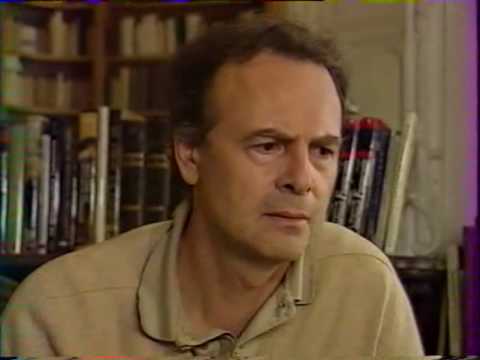
Patrick Modiano


Patrick Modiano, who has been awarded the 2014 Nobel Prize for literature, is one of the very few living writers who means anything to me on a personal level. I read a few of his novels after coming across Voyage de noces by chance about fifteen years ago and being impressed by its style and atmosphere and sense of place (but I remember thinking that it would not translate well into English).

A Reuters report quoted a comment Modiano made in a television interview three years ago: "After each novel, I have the impression that I have cleared it all away. But I know I'll come back over and over again to tiny details, little things that are part of what I am... In the end, we are all determined by the place and the time in which we were born."

Funnily enough, I have recently been trying to make a list of topics that particularly interest me, and one of them is not unrelated to Modiano's recurring preoccupations.

One item on the list runs as follows: The contingent (and unrepeatable) features of any individual's upbringing – which includes as a central element a unique and ever-changing cultural matrix – raises awkward questions about values. We like to think of our core values as being, if not objective or universal, then at least as having some permanent or abiding relevance. But do they?

I was thinking here of both aesthetic and moral values, by the way. Though certain very basic moral – and even aesthetic – ideas could be seen to have universal applicability, particular patterns of moral and aesthetic commitment (involving priorities and preferences) seem far more contingent on time and place and culture.

(My previous post also touches on some of these themes.)

Sunday, October 5, 2014

Sentimental education

Perhaps it has got something to do with having a father who was considerably older than my mother – and who himself was regularly mistaken for someone of an even earlier generation than the one he in fact belonged to – but I have always felt more culturally connected to times previous to my own. I am drawn, for example, to the intellectual culture of the early-to-mid 20th century, and to the latter part of that period for popular culture.

As a young undergraduate, I always used to prefer the late-in-the-day tutorials scheduled for the benefit of part-time, 'mature aged' students. They came on their way home from work in the city, the men in suits, the women smartly dressed and smelling of perfume. They knew stuff I didn't know and had strong opinions about things I had never really thought or even heard about.

There was a woman in her late twenties perhaps whom I used to talk to a lot when I was in my second year. She seemed slightly old-fashioned, out of her time somehow. And it turned out that she had quite – unusual – ideas.

For she had something of an obsession with someone I had only vaguely heard of, someone who was obviously a hero for her and who represented an apparently lost but (in her eyes) glorious cause – the fascist leader, Oswald Mosley. But politics (or political history) was not something I had strong opinions about at the time, and I just took her views as one aspect of a slightly odd and intriguing personality.

Not only the student population but also the academic staff (in stark contrast to today's equivalents) reflected a variety of political and social views, from left to right to totally apolitical.

I took a course on W.B. Yeats which influenced me quite deeply. It was taught by a Hungarian who had written a dissertation at Cambridge on 18th-century English gardens and who was very much in sympathy with Yeats's fin de siècle aestheticism as well as his general political tendencies and social views.

As a young student, I was – like the typical student character in a 19th-century novel – almost drowning in Romanticism. Wordsworth, Coleridge, Shelley, Emily Brontë, Gérard de Nerval, Baudelaire.

Two French novels I read around that time, Adolphe by Benjamin Constant and L'Education sentimentale by Gustave Flaubert, were each centred on a relationship between a younger man and an older woman: dark unpleasant books both of them, but strangely alluring. They and other Romantic texts coloured all my interactions and relationships (or non-relationships!) at the time.

Everything – especially everything female – was seen by me through a kind of literary lens which in retrospect I could have really done without. All that Romantic and pre-Raphaelite baggage made me quite as blind to immediate reality as (in a rather different way) the Mosleyite woman was.

In subsequent years I have come to reject just about everything associated with the Romantic movement. Except one thing, its one true – and overwhelmingly important – insight into the nature of reality: that, morally speaking, the natural world is value-free – there are no values in nature.*

The 18th-century philosophes saw themselves as science-driven and enlightened thinkers, but their deism perpetuated classical notions of a divinely guided universe. Ironically, it took the radical (and often self-consciously emotional) upheaval of the Romantic period to clear the way for a truly scientific and secular view of the world.


* Of course, I don't mean to deny that living beings have values and human beings have moral values, and that we constitute part of the natural world. But since the Romantic period it has been much harder to maintain the view that human values are somehow reflected in – or derive from – non-human realities, whether natural or supernatural. (This point – or one very like it – was made by Isaiah Berlin.)

Sunday, August 3, 2014

Watching, waiting and thinking small

I haven't been posting much lately, partly because I've been preoccupied with other matters and partly because I'm a bit more uncertain these days, not about my basic values so much as how those values might relate to current political realities and options.

As I have explained in the past, my kind of conservatism is pragmatic and responsive to changing circumstances. Any intelligent strategy must be responsive in this way.

And circumstances are changing. In terms of global institutions, power relations and general culture, the post-World War II order is fading or failing and it is unclear what kind of order – or disorder – is going to take its place. One thing which is clear is that the more or less continuous economic progress which has underpinned stability in Western democracies seems to be coming to an end.

Continuing financial and economic troubles portend social and ultimately political crises in Europe and perhaps in the US and other developed countries.

As geo-political and economic realities change, political ideas must change. The basic principles and themes may remain the same but the way individuals interpret them and align themselves doesn't.

Sometimes old ideas gain new relevance, or standard assumptions are exposed as inadequate in the light of current events.

I'm not sure if the political center is shifting in Western countries or if we are simply losing that space which has allowed the center-left and the center-right to cooperate and compete and dominate the political landscape since World War II.

Nor is it clear whether the Chinese model of state capitalism or other possible alternatives to liberal democracy will continue to look viable. Corporatism seems to be making a comeback as well as various forms of economic nationalism. Patriotic protectionism is one of the key policies of many far-right Western European parties (the Front National in France, for example).

I am by nature an observer rather than a player, a political quietist rather than an activist. The distinction between watcher and participator is not a clear one, however. There is no neutral place from which one can watch history unfold; what happens inevitably has ramifying consequences, sometimes very significant consequences. And, if we are talking about epochal changes, everyone will be affected in one way or another.

Could what we are currently witnessing be described as epochal change? I think so. There is certainly a lot going on at the moment.

And, though these changes are driven more by economic realities than anything else, ideas play a part too: the crude, emotion-driven ideas that motivate ordinary people to support this or that leader, to protest or not to protest; as well as the more sophisticated ideas promoted by ideologues and intellectuals.

As I have argued elsewhere, these latter kinds of ideas – the more elaborated and intellectualized ones – are often merely post hoc rationalizations or justifications, attempts to make courses of action decided on for other reasons appear morally or intellectually respectable. But ideological structures also play an active role in recruitment and in defining and sustaining political groupings.

Ideological structures, however sophisticated they may appear, are always inadequate as models of social and political reality. They are merely useful (or dangerous) abstractions, attempts to impose some kind of value-based order on an immensely complex social and political landscape.

When we move from the personal to the political, from the particular to the general, there is always some distortion and loss of meaning. The concepts become thinner and more abstract and run the risk of losing touch with psychological and social realities altogether. At least in the social sciences quantifiable measurements are made which guarantee some kind of link to the real world (tenuous though that link all too often is).

I try to keep my orientation empirical and my main focus on the particular rather than the general, on psychology rather than on political or social theory, on cultures and customs rather than on universalizing ideologies, on particular languages rather than on language.*

In line with this way of thinking, the basic values that I cleave to manifest themselves at the level of individual experience, at smaller rather than at larger scales.

This is reality. This is where we truly live.


* Even the notion of a language is at several removes from reality. There are, of course, dialects and regional and social variations. And, as Noam Chomsky has emphasized, in the end there are only idiolects which change over time: the linguistic structures or sets of structures which each of us has internalized are in the final analysis quite individual and unique.

Wednesday, May 23, 2012

All the best people are dead

A body is not a person. A person is created when a growing body interacts with other bodies in a particular cultural context (language, manners, technologies, values...).

And, from the perspective of this particular person, the people being formed at present and for the foreseeable future will come with serious deficiencies of mind: attention-span limitations, an inability to embrace silence and solitude, no sense of history or cultural continuity. Technological factors are the main culprit.

There will be a small number of individuals (of conservative or contrarian persuasion) who will transcend their circumstances and shine, but on the whole it will remain the case that the best people are dead.

Such a claim need not be absolute or categorical. In fact, it will be stronger and truer if put into hypothetical form. If one espouses certain (you might call them old-fashioned) values associated with self-discipline, restraint, focused thought, etc., and believes current and likely future technological and cultural trends will not support such values then the bleak proposition that the best people are dead (or well on the way to oblivion) seems to follow inescapably.

This sort of claim is routinely ridiculed as the typical and utterly predictable refrain of groups associated with the old order as society changes (as it always has and always will). But a case can be made that this time it's different. (A case I will not attempt to make here, however, merely noting that the digital revolution is quite unprecedented in its scope and intrusiveness.)

And the claim about the best people being gone or fading fast need not be made in a whinging or complaining sort of way. For me, it is an (admittedly sad and regrettable) observation, but also a tribute to teachers and intellectual ancestors.

And finally, with respect to the future, I did speak only of the foreseeable future.

There are other times, other worlds...

Friday, May 4, 2012

Can we dispense with ideology?

It has been the case for many, many years, and is now, of course, even more so the case, that humanity's knowledge-base is so vast and varied that an individual is capable of understanding only the tiniest fraction of it. Specialists devote a lifetime to their little corner, and even then, at least in the sciences, will only make significant contributions by working collaboratively with others.

And yet we (or at least some of us) still hanker for a general understanding of things, a synoptic view. This is what religions and various secular ideologies have provided - something to satisfy our instinct to get to the bottom of things and to situate ourselves within the whole; to make sense of our fleeting lives.

Crucially, we need to integrate our feelings and values with our practical and objective knowledge of the world, and this is what religions and ideologies have done so successfully in the past.

Unfortunately, the most potent forms of religion today are completely divorced from modern science. Islam is locked into a medieval worldview, and the forms of Christianity (and indeed Judaism) which are currently flourishing rely on a blinkered and literalistic interpretation of scriptures composed thousands of years ago.

More intelligent forms of religion (like the views put forward by Erwin Schrödinger to which I recently alluded) are also problematic, in my opinion, largely because they tend to lack content. Rereading Schrödinger, I am annoyed both by the vagueness of his religious claims and by the patrician, sage-like tone. Just a bit too self-conscious. And of course the science is old.*

Political ideologies are not much more satisfactory. The complexity of the social realm makes it impossible to pin down the essentials in a creed or text, and attempts to do so - and apply the creed - have been spectacularly unsuccessful, often resulting in much unnecessary death and suffering.

But one can take the word 'ideology' in a broader sense, denoting a general set of beliefs about the nature of things and about social life and about what is important. In this sense, ideology is a good and necessary thing.

We need to make choices, we need to act, and to do so we need to integrate objective knowledge with feelings and values. I don't think we need to turn to religious traditions for help here (though many do); and of course we should be modest in what we claim for our view of things. But we need something like an ideology if we are to have a synoptic view, and certainly if we aspire to give a coherent and principled account of our actions.


* Interestingly, Roger Penrose contributed a brief preface to the reprint of some of Schrödinger's non-technical writings which I have been reading. Penrose writes that when he was a young mathematics student in the 1950s he didn't read a great deal, "but what I did read - at least if I completed the book - was usually by Erwin Schrödinger." It is no surprise that Schrödinger's mystical view of life and consciousness would have appealed to the man who was to write The Emperor's New Mind.

Monday, January 9, 2012

What's worth doing?

I think we must have evolved for crisis living, not reflection. Reflection bogs us down and causes us to question everything, whereas, in our normal state (lives more or less out of control), we act to deal with this crisis or solve that urgent problem, and often manage to remain cheerful and show courage and all sorts of virtues. Life-in-action brings out the best in us. Leisure and bounty often bring out the worst.

For example, we might start to ask questions like, "What should I do?" or, worse, "What human activities are intrinsically worthwhile?"

This last question in particular is problematic as each of us is situated in a specific social context. Simply asking what human activities are worthwhile is perhaps too abstract an approach. But so long as one is aware that one is dealing with abstractions and provisional generalizations the exercise may not be entirely useless.

And it can streamline discussion and simplify things. For example, I might be at a point in my life where I have to make a choice of direction but don't want to be distracted by a lot of boring details. (My specific situational details are very boring, as it happens.)

So - what sorts of activities are worthwhile, intrinsically or not?


1. Having fun - partying and that sort of thing - will be high on many people's lists. However, not really being dans le vent (to use a dated but expressive French locution), I have little to say about this.

2. Having children and raising them is considered life's purpose by many. Certainly it appears to be the fulfilment of a basic biological function, but what is significant about it has more to do with passing on values of various kinds in a particular cultural context.

3. Charitable and humanitarian work is often worthwhile, but its value is entirely extrinsic, i.e. in terms of the good it does. This is an area where well-intentioned people can do great harm. Good intentions and warm feelings are no substitute for thinking through the (possible) consequences.

4. Political activism. As for 3. Except that the intentions are not always good and the feelings are often far from warm.

5. Art and self-expression are often put forward as intrinsically valuable activities. Though it all depends on the quality of what is being made or said.

6. Enjoying good art or literature is a worthy thing to do, I suppose, but I wouldn't make too much of it. One important thing good taste does indirectly - and on a very modest scale - is to reward good quality art and writing and to limit the audience for (and so discourage) poor quality work.

7. Playing sports and competitive games is great for some. H.G. Wells used to invite friends to his country house for the weekend and he always organized lots of games. But he was inclined to tire quickly of one game after another. "Let's play something I can win," he would say.

8. Hobbies are worthwhile too, blurring the distinction between work and play. They can be a sort of compensation for the unsatisfactory nature of the greater part of one's life.

9. Ordinary social interaction? Well, this is an essential part of being human. (So is sitting alone under a shady tree.)

10. Learning is intrinsically valuable, especially (I am speaking personally here) the sort of learning that helps one understand important things - and things in general. I think the privileged person is the one sitting in the auditorium, not the lecturer. Likewise, scientific researchers (even successful ones) are less privileged than non-researchers who have more time and leisure to understand and appreciate what researchers discover.

After all, lecturers must be paid or they will not lecture (the ones who don't insist on payment you don't want to hear!); and researchers have to be paid and lured on by prizes and awards. But curious people don't have to be motivated by material rewards to learn, to read, to expand their understanding.


Of course, I am being slightly disingenuous here. Though I mentioned (artistic) self-expression, I am underplaying that basic human motivation, the desire for the spotlight, the desire for status, the desire to be taken seriously, to be listened to. And I am also ignoring the fact that most of us have to earn a living and that paid work not only fills a disproportionate amount of the typical day and so determines to a large extent the nature and quality of our lives, but also forms the basis of our identity, of how other people define or categorize us and of how we define and categorize ourselves.

I'll deal with the topic of remuneration in another post, but let me just say here that I don't see any necessary connection between the worthwhileness of an activity and whether or not someone should be paid for doing it.

Wednesday, December 7, 2011

Genetics and political orientation: some further thoughts

Let us assume that - as the research (which I discussed briefly in a previous post) seems to indicate - our political and other values are heavily influenced by genetic and genetic/environmental factors and even reflected in brain structures. What consequences flow from this?

First of all, it will make one skeptical about one's own political beliefs and values. As with someone 'born into' a particular religion, skepticism is definitely called for. But, just as my being born into a particular religion does not mean that the doctrines of that particular religion are necessarily false, so my having a genetic predisposition to believe or value certain things does not mean that these things are not true or valuable.

Even if our political beliefs were completely determined, this would not necessarily reflect on their truth, rightness, viability, plausibility - on their value and worth in other words. But are value and worth matters which can be objectively assessed?

I would suggest that the policy prescriptions of the right or the left or any other political perspective or orientation can be assessed in various ways. Whether particular methods or policies work in practice can be tested (and history can be seen as a record of such experiments). Science can be brought to bear on factual matters, from biology to economics. But basic values - such as whether to value equality over prosperity and individual freedom, etc. - seem not to be amenable to objective assessment.

Another lesson one might draw from the research is that people are different - every brain is unique, of course, but there are also differences which reflect general patterns of thought; and consequently changing someone's mind about a deep ideological issue will not be achieved simply by setting out a logical argument. Of course conversions occur, and people change their own minds (though often, as one of the commenters on the linked post said, as a result of much reading and reflection).

But presumably conversions occur when the new ideology is compatible with underlying brain structures, in other words when elements of that ideology are already present in a latent form. Given the research results, unconscious constraints and unconscious proclivities and tendencies clearly shape the possibilities for individual belief and orientation.

Knowing this, one would not try to convert everybody to one's own way of thinking, but rather accept that many would not be able (without major mental re-engineering) to value the things one values and so think the way one thinks about social issues. One would concentrate on those whose basic values were compatible with whatever social philosophy one was seeking to promote.

Unfortunately, much argument and debate is entered into with the assumption that we all have a more or less identical faculty which we call 'reason' - a kind of logic machine in our heads which determines our views. But - leaving aside areas like mathematics and formal logic - this is not the case. Our thinking is bound up with feeling and with (often unconscious) values. The research results undermine the view that debate and adversarial discussion are truth-seeking activities. There could be a more limited role for discussion, however, in helping those who have certain predispositions to develop a conscious and coherent social philosophy which accords with those predispositions.

It would be nice if we could have a workable dual or multi-choice social, political and economic system, so that we could all just gravitate towards the option we prefer; but unfortunately capitalism needs to be a universal system if it is to work properly. A dual capitalist/socialist (or free market/collectivist) system will fail because the wealth-producing (capitalist) part will always face increasing demands to subsidize the collectivist component.

In fact this is arguably what is happening today. Most Western countries, though nominally capitalist, have large public sectors which are major employers and providers of welfare. A dual (private/public) system operates in many areas of society: there are private schools and public schools, private hospitals and public hospitals, private health insurance and public health insurance, self-funded retirees and retirees on state pensions, and so on.

And - surprise, surprise - public debt is jeopardizing the future of many Western economies and threatening global prosperity.

Monday, October 17, 2011

Do genetic and environmental factors determine political orientation?

So often we see the truth of something, even talk or write about it, but don't fully realize the implications. And for me the implications of an idea which I have accepted for quite some time are finally, I think, sinking in. I'm talking about the idea that our - for want of a better word - ideological propensities (and perhaps values in general) are in large part determined by genetic and environmental factors.

Late last year and earlier this year there was a lot of publicity about a particular study (associated with the actor Colin Firth) concerning correlations between brain structure and political orientation. A paper detailing the results was published in April 2011 in Current Biology, and I had been meaning to have a close look at it, and perhaps to trace reactions and interpretations with a view to forming my own opinion on what it all might mean.

The study found that the gray matter volume of the anterior cingulate cortex was generally greater amongst university students identifying as liberal or left wing, while the right amygdala was larger in those who identified as conservative or right wing.

Predictably, a lot of nonsense was written by journalists and bloggers on the significance and implications of this piece of research - much of it along the lines that conservatives are less evolved!

It goes without saying that our knowledge of how brain structure and brain activity relate to thought and behavior is very limited. Research into these areas is at a very early stage and this study is a small piece of a very large and largely incomplete jigsaw puzzle. What the study does do, however, is to provide evidence that our political propensities are correlated to brain structures, which in itself is a profoundly important result. What it does not do is to validate value judgements about specific political propensities.

As the authors of the study point out, their research extends previous findings which related certain kinds of brain activity to political attitudes. Reference is also made to a study of twins which indicates that genetics plays a significant role in determining political views, and to other studies which have focused on the interaction between genetics and the social environment. "For example," the authors write, "political orientation in early adulthood is influenced by an interaction between a variant of a dopamine receptor gene linked with novelty seeking and an environmental factor of friendship."

Though not mentioned by the authors, research on birth order has thrown significant light on these issues. As I noted in a post last year, first-borns have been found to score higher on conservatism, conscientiousness and achievement orientation; later-borns on rebelliousness, openness and agreeableness. But, apparently, this pattern holds only within (rather than across) families because genetic effects are stronger than birth-order effects.

All in all, it is becoming increasingly clear that genetic and environmental factors play a big role in determining an individual's political orientation - and this is a hugely significant fact. When we engage in political (or similar kinds of) discussion and debate, we can no longer assume that we are dealing with people who - at least potentially - think like us. We all know from experience that such debate is usually (always?) futile, and at last, perhaps, we are beginning to understand why.

It is all very depressing for anyone who has been committed to the value of discussion and debate about values and politics. I want to face the implications of these findings head on. What consequences flow from them? Is ideological discussion a waste of time?

I'm still thinking about it.

Monday, October 10, 2011

Hayek and Hobbes

I recently expressed an affinity for the social views of F.A. Hayek, noting that this position might appear to be difficult to reconcile with my fondness for the writings of Thomas Hobbes (1588-1679).

Hobbes is most famous for his contention that without a strong central authority societies disintegrate into conflict:

[D]uring the time men live without a common power to keep them all in awe, they are in that condition which is called war, and such a war, as is of every man against everyman ... In such condition, there is no place for industry, because the fruit thereof is uncertain: and consequently no culture of the earth; no navigation, nor use of the commodities that may be imported by sea; no commodious building; no instruments of moving and removing, such things as require much force; no knowledge of the face of the earth; no account of time; no arts; no letters; no society; and, which is worst of all, continual fear and danger of violent death; and the life of man, solitary, poor, nasty, brutish, and short. [Leviathan (Basil Blackwell, 1960), p. 82.]

The common power of which Hobbes speaks is conceived as a sovereign individual or group of individuals which is granted supreme power to act 'in those things which concern the common peace and safety.' The sovereign - so conceived - is the source of all law, and rights are a matter of legal definition.

There are obviously conflicts here with the views of Hayek. Hobbes had a major influence on the 19th and 20th-century tradition of legal positivism and the command theory of law, a tradition of thought to which Hayek was steadfastly opposed. Hayek accepted that the idea of law as a command is appropriate in systems of regulation applied to administrators and government officials, but if it is applied to the population at large then everyone is reduced to the status of unpaid servant of the state.

Hayek felt that healthy ideas of the rule of law were undermined in the later 19th century by proponents of legal positivism. The dangerous idea that whatever the government does is right and legal led to the perversion of the Rechtsstaat into the Kulturstaat and to various forms of totalitarianism. It also led to the acceptance of ideas of 'social justice' (involving, amongst other things, the redistribution of private wealth). Hayek believed that laws should not involve arbitrary elements and should be process-based and not directed at particular individuals or towards particular ends. His purpose was to delineate a private sphere where individuals are free to act without fear of coercion by government.

Fundamental to Hayek's position is his rejection of the view that order needs to be created by a sovereign authority. For order arises spontaneously, and any imposed order will - because no central orderer can ever have or process the required information - necessarily be inefficient and oppressive. But I think it's fair to say that Hayek also had a strong belief in individual freedom as a value in itself.

The major threats to individual freedom in Hayek's day were secular totalitarian ideologies (and social democracy which had - as he saw it - a tendency to drift in a totalitarian direction). For Hobbes, however, the main threat was social chaos, but also religious ideologies. Hobbes' sovereign (unlike religious authorities) was not concerned with the private lives of its subjects. Secular totalitarian threats were just not there in 17th-century England, and it is a mistake to see Hobbes as some kind of proto-fascist. Arguably he was just as concerned to protect human freedom as Hayek - and he was certainly opposed to totalitarianism.

Strangely, the tenor of Hobbes' thinking seems quite close to that which led to the development of game theory, one of the most significant new tools of 20th-century economics (and pioneered by Hayek's friend Oskar Morgenstern). Hobbes' suggestion that the individual should first seek peace, but, if betrayed and attacked, is justified in availing himself of 'all helps and advantages of war' to defend himself, approximates to the famous 'tit-for-tat' strategy which generally outperforms other strategies in the 'prisoner's dilemma' game. In one-off versions of the game, the outcome Hobbes predicted occurs and everybody loses (though tit-for-tatters lose less badly than others). But in iterated versions of the game, where artificial agents interact (in what could be seen as a model of society), pockets of spontaneous order and cooperation develop and thrive (providing evidence to support a Hayekian view).

I recognize the reality of spontaneous social order, though I suspect it is not quite so robust as Hayek assumes. As Hobbes (and Hayek in fact) knew from first-hand experience, civil disorder and war are real dangers, and something like Hobbes' sovereign, with strong and undisputed power, may be a necessary condition for peace in many contexts. Certain societies, especially highly cohesive ones with strong systems of morality in place, may be able to exist for long periods without the need for such an authority but history shows that civil conflict can erupt unexpectedly.

Both Hobbes and Hayek saw themselves as men of science, but appreciated also the other dimensions of human culture and the contingency of history. Both men were responding in their work to what they saw as the key social problems of their times in a rational, unsentimental and entirely secular manner. Hobbes' outlook is less colored by religious or metaphysical ideas than that of most of his contemporaries; and, of all the European neo-liberals, Hayek was probably the closest in spirit to logical empiricism, the anti-metaphysical and rigorously secular movement - exemplified in the Vienna Circle - which sought to replace obscurantist philosophies and religions with a view of the world based on science and a new understanding of logic and language.

Who cares about the compatibility or incompatibility of the thought of these two men? Why is the issue even worth raising? Because, I suggest, their differences bring to the fore very important questions about might and right, pragmatism and morality, ends and means.

I have the sense that - for better or for worse - Hayek's thinking retained traces of philosophical idealism, and this may have been what drove him to attempt to justify (certain types of) law on non-legal grounds and to place such an emphasis on human freedom. But the important questions are not what Hayek (or Hobbes) thought about this or that, but rather about what is, and what is not, the case.

Facts and values are intertwined in all discussions of social philosophy, and, if any progress is to be made, they must - no easy task! - be disentangled. The factual questions may be resolved through empirical research and reason, but questions of value will, I suspect, always remain contentious.

Saturday, August 13, 2011

The boat sails on

The stand-alone pages (click under the Conservative tendency banner) are designed to sketch out in a concise way the political and ethical framework within which I am operating. But, since what I have written only imperfectly reflects my ideas, and also because my ideas are slowly evolving, there is a constant need to revise my notes.

I am reminded of Otto Neurath's famous image which compares our body of knowledge to a boat that must be repaired at sea: "We are like sailors who must rebuild their ship on the open sea, without ever being able to dismantle it in dry dock and reconstruct it from the best materials."

Today I put up a revised version of 'Conservatism without religion' under the new title, 'Modern conservatism'.

Sometimes I am tempted to go in a more scholarly direction. For example, I have been reading up on the philosophy of law. But, in some ways, such areas (the philosophy of mathematics is another that comes to mind) can be problematic. They appear rigorous and scholarly, but they lack a mechanism to create the convergence of views which characterizes scientific disciplines.

Debates between, say, legal positivists and supporters of natural law-based approaches - or indeed between legal positivists and legal positivists! - roll on for decades without any real resolution. Such debates produce divergence rather than convergence of opinion - growing lists of elaborate and more or less incompatible theories.

I have tried to avoid getting entangled in this sort of thing, stating my views as clearly and as plainly as I can. Not everyone will agree with what I say. There are facts and there are values, and values are necessarily subjective to some degree.

That's just how things are, and I am inclined to think that life would be a lot simpler and a lot more pleasant if that subjective element were more universally recognized and accepted.

Friday, June 24, 2011

Conservative and libertarian

Though much philosophical and ideological debate, polemic and argument can seem like a waste of time (and frankly much of it is), there will always be a place for it if only as an intellectual safety valve or as the mark of a free society. But can such debate be a truth-seeking activity?

Worldviews or ideologies are a mixture of facts (or purported facts) and (inevitably subjective) values. They can be partially assessed in terms of the facts (or falsehoods) they rely on, in terms of how well they reflect social and psychological realities, and also in terms of internal consistency or coherence.

Though internal consistency doesn't necessarily imply truth, testing coherence can serve a useful (if limited) purpose. Amongst those whose ideas are different but close, discussion can be productive. If I generally think like you but we disagree about this or that, I might be inclined to look again at those issues from your point of view, and you from mine. Two minds which are fairly close trying to reconcile areas of disagreement are not unlike one person finding incompatible elements in his own thinking and trying to bring them into some kind of harmony. There are certainly circumstances when explicitly setting out one's ideas in writing or in a discussion does make a difference.

Such clarifying discourse, however, is pretty rare, as most of the time - whether we mean to or not - we are just playing games, scoring points, defending long held points of view without really putting our beliefs on the line. And these problems are magnified when the setting is institutional and the participants are professional scholars.

The sciences are tethered to reality by strict conventions and procedures. Predictions are made and tested. Adverse results may often be explained away, but adverse results do make a dent in the credibility of those who support the theory in question. By contrast, in non-empirical areas (mathematics is a special case and can be seen as quasi-empirical in fact) the prizes go to those with the most persuasive manners, the most dogged commitment to scholarly tasks (and to writing grant applications), and the most influential friends and allies. Truth has little to do with it, and the proliferation of theories of human rights, justice, morality, equality, etc. is just about as far from science (which is marked over time by drastic pruning and convergence) as it is possible to get.

There is also the unfortunate fact that scholars with left-wing or (so-called) progressive views have, to a large extent, taken over the teaching of the humanities in universities as well as most of the important journals. One example: a preference for "creative" and "novel" approaches by the Journal of Social Philosophy is combined with a clear left-wing bias. The journal, edited by Carol C. Gould, "seeks to publish creative approaches to practical and normative issues ... such as those arising from economic and other forms of globalization, violent political conflict, and the multiplicity of cultural experiences worldwide." It "gives priority to the development of novel theoretical frameworks from social ontology to care ethics to cosmopolitan theories of democracy, human rights and global justice."

So is social philosophy just a cover for ideological posturing and empty talk? Not necessarily. But, clearly, the sort of thing promoted as social philosophy by the Journal of Social Philosophy is far too influenced by current ideological fashions. It is all too easy covertly or unwittingly to build values and biases into theories and models in the humanities, and the "novel theoretical frameworks" being sought are sure to be shot through with implicit values. A different style of social philosophy could, though, usefully identify hidden values and biases in social scientific research. Scientific disciplines must eschew values if they are to be truly scientific but reflection on such disciplines can legitimately incorporate substantive and explicit discussion of values as a central element.

System building in social philosophy and related areas is problematic. The countless systems and theories which have been elaborated are just so many incompatible and ultimately crude attempts to encapsulate the immense complexity of social reality into a linguistic construct - thin and static models of a dynamic world. (Computer simulations may, however, manage to capture important aspects of social reality.)

For me, then, social philosophy is mainly critical and analytical, but it can also involve the articulation of principles, directions, ideals and preferences.

The tradition of social thought which I favor draws on both conservatism and libertarianism because these currents of thought not only - as I see it - reflect the realities and the possibilities of human nature, but also because they do not appeal to grievances and resentments as leftist ideologies tend to do. Conservatives respect the cockeyed wisdom of tradition, libertarians the rationality of ordinary people (imperfect though it is and we are).

Both conservatives and libertarians embrace the present and, though they look to the future and hope, they do not, like radical leftists, look for salvation there... Life - when all is said and done - is good.